Showing posts with label caf. Show all posts

Sunday, December 22, 2013

No Pirates, No Chiefs, No Sundowners. Gordon Igesund's African Nations Championship plans in disarray

Trouble brewing: Gordon Igesund's Cup of
Coffee approach may not work this time

The traditional Christmas “ho, ho, ho” has been notably absent in the Igesund household since Friday.


Bafana Bafana head coach Gordon Igesund’s preparations for the African Nations Championship were thrown in to disarray at the end of last week when the PSL shook up their January fixtures, a move which is likely to leave hosts South Africa with a severely depleted squad.


Igesund, who’s never been one to mince his words, is supposed to name his 23-man squad for the CHAN tournament tomorrow. He growled: “There is nothing we can do. I have to prepare for this tournament not knowing who I can pick. It’s not an ideal situation.”


The CHAN tournament – limited to players from the domestic leagues around Africa – should have been a showcase for South African football’s resurgence and the PSL, recognised as one of the most lucrative leagues on the continent.


Bafana will play all their Group A games at the Cape Town Stadium, starting with Mozambique on January 11, then Mali on the 15thand Nigeria on the 19th. The final is scheduled for Cape Town again on February 1.


With Orlando Pirates reaching the African Champions League Final against Egypt’s Al Ahly, the tournament was seen as perfectly timed for Igesund to continue the nation’s footballing revival after the rousing 1-0 win over world No 1 Spain.


Instead, it appears Bafana will have little chance against the likes of Nigeria, Libya, Congo and Ghana in a 16-team tournament which is NOT being played on FIFA dates, allowing clubs to withdraw their players at will.


Igesund explains: “Look, we had come to a compromise. There was the orginal agreement where I was told I couldn’t pick players from Pirates, Ajax Cape Town, SuperSport United and AmaZulu because they would be playing league games.


“Now we have these new fixtures and I can’t even comment on it.”


The PSL fixtures now rule out participation from the PSL’s top two sides, Mamelodi Sundowns and Kaizer Chiefs, which this statement of explanation offered on Friday: “Due to the heavy backlog created by the progression of Orlando Pirates in the Champion League, it was decided postponed matches would be played in January to avoid fixture congestion.


“In addition, both Chiefs and SuperSport will be playing in the 2014 CAF Champions League and Confederations Cup in February.”


Dominic Chimhavi, the SAFA spokesman, clearly aligns himself with Igesund: “We expect the original agreement to stand and we don’t expect anybody to abrogate it. Only Pirates, Amazulu, Ajax and SuperSport should be affected.


“This is the second biggest tournament on the continent as as hosts, we have to use our best players on home soil.”


With a friendly against Botswana including a three-day camp planned to culminate on Saturday, Igesund said: “I submitted a list of 23 players to the Danny Jordaan last week. He went into a meeting with the PSL and I’m waiting to hear the outcome of that. I need clarity, but from what I can tell, there has been a compromise. It’s been a big challenge because I’ve already changed my team five or six times.”


If the PSL refuse to relent, Igesund could turn to a few of the old guard – particularly Matthew Booth and Moeneeb Josephs, who have helped make third-placed BidestWits the best defence in the PSL this season.


But dreams of a super-team from the top echelon of the PSL appear to be in tatters. Still, it could be worse. Last I heard, Steve Keshi’s Nigeria haven’t even got kit to play in at CHAN.


BOLLOCKZ! my own football show on www.ballz.co.za, airs every Thursday from 9am. See the Ballz channel on www.YouTube.com for our growing collection of interviews with the big names in South African football.


You can also follow me on www.twitter.com/nealcol for all the latest sports news… and read my “Neal and Pray” column every Tuesday in www.thenewage.co.za.


BOLLOCKZ! is backed by www.topodds.com - have a look at their site for my latest sports betting advice and how we are doing in using @thumperpigeon's R5,000 to make money for the Ballz charity WINGZ OF CHANGE.


Monday, November 11, 2013

Two good reasons to celebrate Orlando Pirates unexpected progress to the African Champions League final: two clubs, no lasers

Under the spotlight: Senzo Meyiwa is lit up by laser
beams wielded by unruly Al Ahly fans in Cairo


IT took one interview and a quick phone call to finally bring the footballing authorities to THIS startling revelation: Green laser beams are BAD for the African Champions League.

South African viewers on SABC and SuperSport were infuriated during Orlando Pirates 2-0 defeat against mighty Egyptians Al Ahly on Sunday night in Cairo with their players constantly picked out by the annoying green lights.

Annoying? According to the experts (including the Royal Institute for the Blind), the hand-held lasers – smaller than a torch, about the size of a pen – can DAMAGE the sight of footballers targeted by unruly fans.

I made my debut on South Africa’s 24-hour news channel ANN7 today (see video below) and chatted to Peter van Onselen on his brand new lunch-time news show Express Lunch, making the point that lasers are BANNED in European sports stadiums (and in the US and Australia, though apparently it’s still a problem in Latin America).

Following a spate of idiots shining lasers in the eyes of airline pilots at major airports, injudicious use of the “laser lights” – originally developed to assist army snipers and marketed as a tool for university lecturers to highlight salient points to students – now involves heavy fines and even jail sentences.

But despite the use of lasers in Pirates’ two group games in Egypt and in the semi-final against Esperance in Tunisia, CAF chose to erm… turn a blind eye.

It was only thanks to complaints from sports minister Fikile Mbalula and Buccaneers coach Roger de Sa that I was able to call new SAFA president Danny Jordaan after my ANN7 interview and ask: What will be done?

Danny told me: “Yes, we are aware of the problem and the outcry around the country about the lasers in Cairo. We are writing a letter of complaint to CAF and FIFA about their use.”

Like me, Jordaan is concerned that nobody was searched going in to the ground and the stewards did not act against the fans using the lasers at the jam-packed Arab Contractors Stadium. He said: "This is on the record, I'm happy for you to put this out. We had to act."


With any luck, Jordaan’s complaint – the 2010 World Cup organiser has real influence at CAF and FIFA – will enable Kaizer Chiefs to represent South Africa in the 2014 African Champions League without that particular problem.

But there are other reasons for South Africans to celebrate Orlando Pirates’ epic crusade through the continent over the past six months. Amid the debate between the AmaKhosi and the Ghost over just how much celebrating we should be doing around a final defeat, it’s worth noting that the FOUR points Pirates earned for losing in Cairo will earn an automatic second place in the Champions League in 2015.

And if Kaizer Chiefs (and Platinum Stars in the Confederations Cup) get to the group stages, South Africa are guaranteed a second major rise up the CAF club rankings in 2016 after a decade in the doldrums.

The current top twelve, in order and based on results over the past five years in both CAF competitions, looks like this: Tunisia, Egypt, Nigeria, Sudan, Morocco, DRC, Algeria, Mali, Congo, Angola, Cameroon, Ghana

But Pirates unexpected progress via the Comores, Zambia, DRC (though we never got to see it on the television), Congo, Tunisia and Egypt (thrice) means South Africa should move ahead of both Ghana (11 points) and Cameroon (12 points) next year.

For that reason alone, Roger de Sa and his Pirates deserve credit. But it won’t come easy. Given their current position in the PSL (they’re rock-bottom) and a seven-match streak in the Champions League which ended LLDDDDL, he’s already under pressure as the fireworks cool in Cairo.

But if the Buccaneers WIN all their six or seven games in hand, they can go five points clear of current leaders Mamelodi Sundowns. It's a big IF. But that might quiet the critics. Roger that.


BOLLOCKZ! my show on www.ballz.co.za, airs every Thursday from 9am. See the Ballz channel on www.YouTube.com for our growing collection of interviews with the big names in South African football.


You can also follow me on www.twitter.com/nealcol for all the latest sports news… and read my “Neal and Pray” column every Tuesday in www.thenewage.co.za.


BOLLOCKZ! is backed by www.topodds.com - have a look at their site for my latest sports betting advice and how we are doing in using @thumperpigeon's R5,000 to make money for the Ball's charity WINGZ OF CHANGE.


Sunday, November 3, 2013

African Champions League final: Pirates go to Cairo with a fighting chance thanks to a moment of Matlaba magic

Relief of Orlando: Thabo Matlaba celebrates
his late equaliser on Saturday night
THERE was only one place to be on Saturday night. Orlando. The Pirates. Our African Champions League finalists reaching for the stars, uniting the football-speaking nation.

Trains shooting past, blaring their hooters in support, motorways laced with the skull and crossbones, a packed house of 38,000, an army in black and white, interspersed with those in gold and black adding their voices to the national clamour for a second star.

The stage has rarely been better set, whether you prefer the ear-splitting choir of vuvuzelas or a rousing rendition of Shosoloza.

But much like their successful quest for continental domination in 1995, the home leg of the final was not quite what the nation had hoped for. A 1-1 draw in Soweto.

LEGEND: With 1995 final-winner Jerry Sikhosana
at Orlando Stadium on Saturday
When they drew the home leg of the final 2-2 against Ivory Coast’s ASEC Mimosas 13 years ago, coach Joe Frickleton was sacked before the second leg and few expected that dramatic away win, courtesy of Jerry Sikhosana’s unforgettable 73rd minute strike.

But Thabo Matlaba’s stunning last-gasp equaliser on Saturday night offers, as I said to coach Roger de Sa immediately after it went in, “a fighting chance” for a side increasingly adept at grabbing draws from the jaws of defeat.

Ah, Drawlando. Their last six Champions League games go LLDDDD. Though the Buccaneers dominated possession – they enjoyed around 68% of the ball - and got plenty of crosses in to the box from Tlou Segolela and Daine Klate, I don’t remember an isolated and impotent Lennox Bacela winning anything in the danger area.

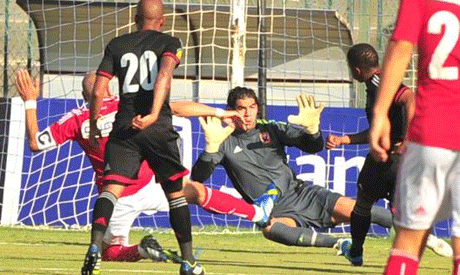
In midfield, the great Andile Jali looked a shadow of his former self, losing possession and growing ever more sluggish as the game against champions and seven-time champions Al Ahly of Egypt wore on. Egypt’s No1 goalkeeper Sherif Ekramy was really stretched only once, brilliantly denying Jali with a strong right hand at full-stretch.

In midfield, Oupa Manyisa pulled the strings and centre-backs Rooi Mahamutsa and Ayanda Gcaba took enormous risks in an effort to push forward after Mohamed Aboutrika’s free-kick had given the visitors a shock lead with a perfectly-placed free-kick from 25 metres.

To be frank, even the too-little-too-late arrival of experienced Zambian striker Collins Mbesuma looked unlikely to save the Pirates, who were lucky to escape a second Al Ahly goal, Ahmed El-Zaher’s effort unfairly ruled offside early in the second half.

Matlaba’s last-gasp effort was as unexpected as it was welcome. Mr De Star insisted afterwards: "We didn’t just sit back, we were offensive, we pushed midfielders in to the attack, we used real wingers, not wide midfielders.

“For the 90 minutes we kept on trying, we didn’t resort to long balls. We didn’t lose our heads. We were patient, we built it up.”

Ultimately, a 1-1 draw – their fourth successive stalemate in the African Champions League – was a highly fortunate result though the frustrated Pirates can rightly claim to have been the better side.

They go to Cairo with captain Happy Jele and midfielder Jali suspended - but the out-of-favour Lucky Lekgwathi and Vieira Masalesa offer obvious replacements.

De Star said: "We still have a fighting chance. There were plenty of coaches in the ground tonight, but I enjoyed it. We showed character, we can turn this around in Cairo next Sunday.

"I don't know if there's a limit to what this lot can achieve, but they just keep pushing. Look, it’s going to be very difficult there’s no doubt about it, but we’ll go there to win."

Truth is, they don’t need to. A 2-2 draw will earn a second star on away goals. 1-1 will force extra-time and penalties. 0-0 will see Al Ahly retain their African crown on that single free-kick, their only real shot on goal away from home.

But to end it as they did in Abidjan 13 years ago, with a win against all the odds, would be a perfect finish to an exhausting Mission Improbable. They have the talent. They have the squad. But do they have the experience against the gritty Egyptians in front of their first real home crowd in months?


BOLLOCKZ! my show on www.ballz.co.za, airs every Thursday from 9am. See the Ballz channel on www.YouTube.com for our growing collection of interviews with the big names in South African football.


You can also follow me on www.twitter.com/nealcol for all the latest sports news… and read my “Neal and Pray” column every Tuesday inwww.thenewage.co.za.


BOLLOCKZ! is backed by www.topodds.com - have a look at their site for my latest sports betting advice!

Sunday, August 4, 2013

HISTORICAL, HYSTERICAL: Orlando Pirates 3 (three, drie, trois, drei), El Ahly 0 (niks, nothing, nada, zilch)

Walking the plank: El Ahly goalkeeper Ekramy in Al-Gouna yesterday


القراصنة ثلاثة أهداف، "الأهلي لا شيء


I am reliably informed the sentence above is Arabic for “Orlando Pirates three goals, El Ahly NONE.”


And really, despite a fascinating start to our own Professional Soccer League, that is THE story of the weekend. Egyptian giants El Ahly hadn’t failed to score a goal at home since 2004. But Roger de Sa’s continental crushers gave them the kind of beating we won’t forget for a long, long time.


An opening goal from Thandani Ntshumayelo after an astonishing interchange with Collins Mbesuma made it 1-0 after 18 minutes, then came an incredible THIRD successive African Champions League penalty save from Senzo Meyiwa from Waleed Soliman in the 38th minute.


Just before half-time, the Algerian referee sent off Ahmed Abdul Zaher for dissent as he howled about yet another crunching Pirates tackle – and El Ahly, the defending African champions and three-time winners, never really recovered.


The second half belonged to Andile Jali. First he converted a 73rd minute penalty after Fathy (pronounced Farty) had felled Daine Klate, then – two minutes later – the Bafana reject produced a delightful little scooped pass to put Sifiso Myeni away for the third goal.


And that was it. In front of a windy, empty stadium at El Gouna on the Red Sea coast, the Egyptians were simply flabbergasted by the Pirates defence – the ageless Lucky Lekgwathi (estimates put him at 37) saved one of the line and tackled with all the subtlety of a Pharoah’s tomb.


It was at half-time I sent the under-pressure Pirates coach De Sa my usual SMS. Ths one said: “YOU FYCKING BEAUTY! ROGER DE SA YOU ARE A LEGEND!” He replied with "Yeeeepeeee" (see screen grab of SMSes above).


After the match, Roger said: “Fantastic result but look, we’re not getting carried away, there’s still four games to go in the group.


“I’m very happy but now I have to make sure we stay grounded – and get positive results.”


So you can rave all you want about Kaizer Chiefs’ hard-earned 1-0 win over promoted Mpumalanga Black Aces on Friday night. Clive Barker’s Dogs weren’t a million miles from humbling Stuart Baxter’s double-winning Gods in the PSL’s opening salvo.


And we can praise Cavin Johnson’s SuperSport United – 4-1 winners over Steve Khompela’s Free State Stars on Saturday – or Pitso Mosimane’s Monyloadi Signdowns for their 3-1 at tricky Bloemfontein Celtic. Some might say both were aided by harsh red cards.


But nothing compares with Pirates’ epic victory in El-Gounah. They go top of Group A on goal difference from Congo champions AC Leopards, who saw off Zamalec 1-0 in Dolisie.


Egypt’s Red Devils’ hadn’t lost at home since Tunisia’s Etoile Sahel beat them 3-1 in Cairo to lift the Champions League trophy six years ago. The game was played in afternoon heat and a gusting wind – but nothing could stop De Sa’s Buccaneers.


That second star may not be as impossible as we once assumed. As I said on twitter, a 3-0 win in Egypt is like the Springboks triumping 60-0 in Wellington or the Proteas enjoying a six-wicket victory in Delhi. Unthinkable.


BOLLOCKZ! my show on www.ballz.co.za, airs every Thursday from 10am-noon. 


You can also follow me on www.twitter.com/nealcol for all the latest sports news… and read my “Neal & Pray” column every Tuesday inwww.thenewage.co.za. A shorter version of THIS story will be published in The New Age on Tuesday.


#BOLLOCKS is backed by www.topodds.com - have a look at their site for my latest sports betting advice!

Sunday, April 7, 2013

The shocking truth about CAF: Danny Jordaan on how the French-speaking nations have left South Africa powerless

The man who SHOULD run CAF: Danny Jordaan and Nelson Mandela


DANNY JORDAAN returned home from his abject electoral defeat in Morocco last month deeply disturbed by what he saw at the Confederation of African Football elections in Marrakesh – and bitterly regretting he represents a nation labelled “English-speaking”.

Jordaan, shockingly beaten to a four-year term on the CAF executive by the mysterious Madagascar FA President known only as Ahmad, has every reason to feel aggrieved.

Jordaan is a former SAFA CEO who successfully organised Africa’s first World Cup in South Africa in 2010. He is close to FIFA president Sepp Blatter and has a “great working relationship” with spokesman Jerome Valcke.

Born in Port Elizabeth, he has a strong record as an anti-apartheid activist who was banned and harried by the Apartheid regime. He also played provincial cricket and football before moving in to administration where he led the Cape Town Olympic bid before moving in to SAFA’s highest ranks.

And this bloke Ahmad? FIFA admit they have “no further information” about the man. Not even his full name. There is simply nothing about the Madagascar FA he runs ANYWHERE. But I can tell you that, under his guidance, Madgascar are currently 188th in the FIFA world rankings, their lowest ever, after losing to Equatorial Guinea in the 2014 World Cup preliminary qualifiers. They are also 47th out of the 54 African nations, just behind Swaziland. Hardly a powerhouse, hardly a great recommendation for Ahmad.

Danny and I go back quite a way. He’s told me some of his apartheid stories and any suggestion he is not the perfect man to run CAF is laughable. I launched in with: Defeat against Madagascar?! He shrugged: “We had an agreement the position on the CAF executive wouldn’t go to one of the islands, but it did. COSAFA is mostly English and Portuguese speaking but now we have two French speaking representatives.

"When I got to Marrakesh, Michael Platini (the famous Frenchman who covets Blatter’s hot seat as head of FIFA) had been there two days. He was there for another day after I left.

“I don’t think you must personalise it. Any South African would be seen as a threat to the President. People know when they come to South Africa they will have the environment and infrastructure to play under the best conditions.

“They appreciate that. But it is the other interests, the ones which cannot be balanced with the real interests of football.

“In the north, it’s worse. The French dominate. It sets a precedent. It’s not fair representation. It’s a question of leadership. It doesn’t make sense. These are issues we have to discuss.

The Francophone nations: from Wikimedia.org
“When you look at Southern Africa, the election outcome goes against the agreement we had. It is only in the interests of those who want to pursue a particular path for football in Africa and at FIFA. Those are things I don’t want to talk about.

“South Africa’s role is appreciated, we mustn’t think we’re not wanted on the continent. We must simply understand it’s all about the next CAF president, the next FIFA president.“

“Platini had it all wrapped up. He stands for the French-speaking nations, that is his powerbase. Now 83 percent of the CAF executive is Francophone.

“Just ask Nigeria. Their guy lost to Moucharafou Anjorin from Benin who had just come out of jail after six months. But he’s loyal to Issa Hayatou and the “big five” French speaking nations in CAF.”

It was Anjorin who lashed out at English FA Chairman David Bernstein at the 2011 FIFA elective congress in Zurich when the English asked for a postponement before Blatter’s re-election.

Anjorin was jailed for several months last year amid allegations of “financial impropriety over missing sponsorship funds” but had no problem getting onto the CAF executive ahead of Nigeria, crowned the 
African Cup of Nations champions in South Africa a month before.

Then there’s war-torn Mali's Amadou Diakite, whose ban from "all football activities" ended on October 20th 2012. He bounced back with an incredible 35 out of a possible 54 votes to take his four-year term on the executive.

Jordaan admits: “All English-speaking candidates lost, Platini and Hayatou saw to that. I have to look beyond Hayatou – I think some were worried if I got on the excutive, I might be the next president, and I’m not French!

“I spoke to David Dein from England. The truth is the English, who invented the game and run the best-watched league in the world, now have NO SAY AT ALL over what happens in football.

“Platini is ensuring the influence of the English-speaking nations is non-existent. And South Africa is paying the price for that.

“The only way out of it I can see is for the Commonwealth to become a footballing body. To act as a voting bloc at FIFA. Perhaps then our voice will be heard. That would united the English-speaking nations. But right now the Commonwealth countries do not deal with football and the sport doesn’t feature in the Commonwealth Games.

“CAF elections, sadly, have nothing to do with the good of football. They are for power and money. That is the truth.

"Morocco is history now. But change is coming in FIFA and CAF, I'm confident that we will have a excuitive member in CAF by 2015."

South Africa’s only representative at CAF executive level is former school teacher and SAFA official Molefi Oliphant, a co-opted member who rarely raises his head above the parapet.

Jordaan is not alone in his discontent, Safa executive member Buti Lerefolo, in Marrakesh as an observer, said: “It was not only South Africa, but Nigeria was also marginalised. We were sabotaged. Africa did not vote for us and all we could hear were whispers that South Africa has a lot of money.”

A dossier suggesting South Africa post-World Cup corruption re-emerged in Morocco and after initially coming out in support of their man, SAFA president Kirsten Nematandani issued a brown-nosed statement saying: “We have no doubt they will take our confederation to new heights and we look forward to working with the Caf executive committee to improve the sport on the continent.

"We are grateful for the support shown by our sister federations for SA's candidate."

Confused? So am I. Jordaan says: “The Arabic countries have too much power, the Francophile nations hold sway. Something has to be done.

“Our job is to help develop the game, the under 15, the referees, the facilities. That’s where my heart lies. We have to get away from these political discussions.

“The challenges are backing Bafana, backing the game in Africa. We must distinguish between what is real and what is done for political purposes.

“To have documents that are faceless and nameless, designed to smear people? That must stop. Let’s go face-to-face. Give reasons, this dossier – it’s an insult to call it that – is not right. For the good of this country, we don’t want the world to sit back and shake their heads.

“We must retain our integrity. We have global support.”

A shorter version of this story will appear as my Neal and Pray story in www.thenewage.co.za on Tuesday.

Saturday, December 29, 2012

How Soccer City was saved: a wunch of bankers sees sense before AFCON 2013


My interview with Gareth Edwards on eNCAnews featured an appeal to FNB over the naming of Soccer City, venue of the opening – and closing – games of AFCON 2013. Within hours, the bankers had agreed to renaming “The National Stadium” allowing Bafana Bafana v Cape Verde to go ahead on January 19. FIFA and CAF won’t allow “sponsored” stadiums in their tournaments.

Tuesday, January 31, 2012

Rampant corruption, 11 foreigners and $1m bonuses: Why nobody should support Equatorial Guinea on Saturday


WHEN Equatorial Guinea take the field for their CAF quarter-final on Saturday in their capital Malabo, look carefully at the names on offer. And the money on offer.
You may find that NOT ONE of the co-host's players was born in the country they are representing. That their vice-president’s $1m bonus for every win is going out of the country as fast as the rest of Equatorial Guinea’s oil revenue.
On Supersport, we’ve twice seen Benni McCarthy offering glib approval of Equatorial Guinea’s ridiculous bonuses. The Orlando Pirates veteran told Robert Marawa: “It’s great, anybody will perform for that kind of money!” But hold on Benni, what’s really going on here?
Just how does Teodoro Nguema Obiang Mangu, the son of the president, manage to find the cash to pay $1m for a win and $20,000 per goal to his lowly-ranked players from every nation except his own?
And exactly how did his tiny nation manage to produce a squad of players which features six Spaniards, an Ivorian, a Cameroonian, two Brazilians and only a smattering of actual so-called Equatoguineans? On January 18, barely a week before the big kick-off in Bata, former coach Henri Michel reportedly resigned over Teodoro interfering with his squad, with Brazilian Gilson Paulo taking over. I guess he speaks the language – he has already had his lucrative contract extended by the kindly vice-president.
Perhaps we should be asking too, how a nation smaller than Swaziland managed to see off Nigeria in the bidding for the competition, given that they had never qualified for the finals before. Bit like 2022 World Cup hosts Qatar I guess.
But no, we must ask no questions. When the hosts (ranked 150thin the world by FIFA) take on Ivory Coast (16th) in their surprise quarter-final on Saturday, we shall take the line FIFA took: It’s nothing to do with us, CAF look after the African Nations Cup.
So we must simply accept that Didier Drogba, Yaya Toure and Co will be playing a mercenary army on Saturday. When they upset highly-fancied Senegal last Wednesday, their winner was scored by a Spanish Fourth Division striker called Kily.
They also boasted a Brazilian goalkeeper, a Liberian defender, an Ivorian midfielder and a Cameroonian forward, as well as a host of Spanish players.
Go through the names in their 23-man squad and you’ll find only third choice goalkeeper Felipe Ovono and reserve defender Jose Bokung were born in Equatorial Guinea.
They call their team “National Lightning” but by thunder, they haven’t struck twice in the same place since 2004 when a Brazilian called Antonio Dumas took over as national team coach.
Dumas was the guy who used to run the equally dodgy Togo national side. He introduced several “foreigners” there, many from Latin America and claims he was encouraged by the Equatorial Guinea government to do the same with his new side after disappointing performances in CAF and the World Cup.
A former Spanish colony, the trend was set. Passports and work permits were granted to virtually any footballer who was willing to gain citizenship and play for the oil-rich nation.
Take journeyman defender Lawrence Doe. A veteran of a dozen professional clubs all over the world, he never managed to break into the Liberia side.
He insists: "I feel very happy and very proud because even though I was born Liberian I am now a Guinean. Equatorial Guinea is my home, I have my wife and son here now.
"I am a Guinean, they take care of me, the government take care of me here.”
But nobody seems to care what the locals think, the president and his son have made sure of that over the last 32 years of dictatorship – the longest in the world since the departure of Colonel Ghadaffi in Liya.
Teodorin, the popular name given the son of president Teodoro Nguema Obian Mangue (like North Korean dictarors, they like to keep the naming convention simple) is an expert at cleaning oil soaked millions.
Though he claims to be paid a mere $7,000 a month for his role as minister of agriculture and forestry in the tiny oil-rich enclave, Teodorin is watched carefully by an organisation called Human Rights Watch. On October 6 last year, the US Justice Department filed an official notice in California of a pending claim for the forfeiture of more than $70 million in assets, including a mansion, jet, and Michael Jackson memorabilia belonging to the younger Mr. Obiang.
Though living standards are low in Equatorial Guinea, Teodorin likes to live the highlife on his meagre salary. And pay his football team huge bonuses. But Arvind Ganesan, a director at Human Rights Watch says: “US authorities have turned up stark evidence of corruption by President Obiang and several of his family members in multiple investigations since 2003. The move to go after his son’s US assets, though belated, is a good step.”
And it’s not just in the US that Teodorin makes hay. He is also being investigated in France and Spain, along with his dad, Obian family members and close friends.
The Justice Department initiated the investigation in 2007, following a US Senate investigation from 2003 to 2004. The Justice Department’s legal action names Sweetwater Malibu LLC, a company belonging to Teodorín Obiang, and seeks the forfeiture of a variety of valuable assets, including a $30 million Malibu mansion, a $38.5 million jet, seven luxury cars worth almost $3 million and valuable Michael Jackson memorabilia, such as “one white crystal-covered ‘Bad Tour’ glove.”
The US investigation centres on the “Riggs Bank Report” which was reported by Senate to have “turned a blind eye to evidence suggesting it was handling the proceeds of corruption”.
Essentially, millions of dollars of Equatorial Guinea’s national oil revenues were transferred to a private offshore account that Senate investigators concluded was controlled by President Obiang.
Now the Immigration and Customs department have declared they will “identify, trace, freeze and recover assets within the United States illicitly acquired through kleptocracy by Teodoro Nguema Obiang and/or his associates.”
They believe Teodorín Obiang laundered more than $110 million in suspect funds through US bank accounts between 2004 and 2008. They also claim he transported 22 vehicles out of the US to Equatorial Guinea via France in 2009, according to a Le Monde report, citing customs records. Oh, and there was a party with a tiger in California which cost untold millions too.
Neither the government of Equatorial Guinea nor Teodorín have responded publicly to the news of the pending asset forfeiture action, though in 2010 Obiang’s government released a statement saying the allegations are clearly “clearly RACIST, XENOPHOBIC, ARROGANT and SEGREGATIONIST” (their capital letters) while expressing “complete support, confidence and backing” for Teodorín.
The French are worried too. According to Le Monde last year, French police have catalogued Teodorin’s recent purchase of nearly $26 million on antiquities and other goods at auction.
And then there’s Swaziland. Police there opened an investigation into the theft in late August of a suitcase belonging to the younger Mr Obiang that reportedly contained some $400,000 in cash ($300,000 in dollars and 75,000 euros) and two expensive wristwatches. He reported the suitcase stolen from the five-star villa where he was staying during a visit.


BREAK OUT ON EQUATORIAL GUINEA
Equatorial Guinea, with high oil revenues and a tiny population, has one of the highest per capita gross domestic product ratios in the world.
. But the government has failed to make improvements in socio-economic conditions commensurate with available resources.

The per capita GDP is equivalent to that of some of the worlds’ top-tier economies yet many of the people of Equatorial Guinea lack access to basic social services. The country is 19th worst in the world for child mortality, according to 2010 UN and World Bank statistics. Education spending as a percentage of GDP is lower in Equatorial Guinea than in neighboring countries. The government has invested huge sums in high-profile projects, such as ultra-modern hospitals, luxury conference centers, and a lavish $830 million resort complex built to host the June 2011 African Union summit meeting that have little benefit for the poor.

After Human Rights Watch published a 2009 report on oil, corruption and human rights in Equatorial Guinea that detailed government abuses and the lack of transparency, the Obiang government responded by accusing the group of “blackmail” and “pulling from their sleeves information that lacks all transparency and objectivity.”

The US State Department’s human rights report for 2010 describes an array of serious abuses, including unlawful killings, systematic torture, and official impunity and denounces “official corruption at all levels of government” in Equatorial Guinea, specifying that “[t]he president and members of his inner circle continued to amass personal profits from the oil windfall.”

The legal proceedings involving Teodorín Obiang come as speculation mounts that he is being positioned to succeed his father in power. On October 14, the Obiang government set a November 13 date for a referendum on proposed changes to the constitution. The centerpiece of the announced reform is the introduction of term limits that would allow the 69-year-old President Obiang, who has been president for the past 32 years, to serve for two more terms of 7 years each.

President Obiang was re-elected in 2009 with 95.4 percent of the vote in an election with weak international monitoring, raising “the suspicion of systematic voting fraud” according to the US State Department.

While the government has not yet published a text of the constitutional changes that will go to a vote, they are understood to create a new post for a vice-president that observers expect will be filled by Teodorín Obiang.

In 2010, Teodorín Obiang was elected to head the ruling party’s youth wing, which automatically conferred on him the vice-presidency of the ruling party. The US public relations firm that represents the government of Equatorial Guinea and also has a separate contract with the younger Mr. Obiang, hailed his selection as “part of a broader effort by the government to improve the democratic election process for its citizens.”

Along with declaring the date of the national referendum, Equatorial Guinea also announced that Teodorín would be its deputy permanent delegate to the Paris-based United Nations Economic, Scientific and Cultural Organization (UNESCO). President Obiang has unsuccessfully sought to reinstate a controversial UNESCO prize financed by and named after him. The senior Obiang’s most recent effort to force UNESCO to issue the award, in September, was scuttled in part because news of the seizure of Teodorín’s assets in Paris, a short distance from UNESCO’s headquarters, highlighted the risk of associating the organization with the reputations of the Obiangs.

“The people of Equatorial Guinea should be able to choose their government in free and fair elections, hold it accountable, and apply the country’s wealth to fulfill their basic needs,” Ganesan said. “Unfortunately, President Obiang does not provide leadership that respects such basic rights, and his son seems to be following his father’s path.”