Friday, April 19, 2013

South Africa v FIFA: Fikile Mbalula, SAFA, SASCOC and match-fixing: what's at stake (plus eNCAnews footage)

WITH South Africa facing serious allegations of match-fixing, FIFA and SAFA are at logger-heads over the way ahead - and Bafana Bafana could pay the price.

Ultimately (see video above, from today's eNCAnews) it comes down to this: South Africa must obey FIFA, deal with the match-fixing report and suspend the relevant SAFA members OR they must defy FIFA, hold a more general government inquiry in to SAFA's affairs and present their conclusions.

Tonight Kirsten Nemetandani, the SAFA President, insists there is no threat of a FIFA suspension but the world football body is KNOWN for taking sweeping action if they do not get their way. South Africa's increasingly promising crusade to reach the World Cup in Brazil next year could be in jeopardy.

It's Bafana Bafana the people care about, not SAFA's suits. And though I generally agree with Sports Minister Fikile Mbalula, I suspect FIFA's Jerome Valcke - now a South African citizen through marriage - knows certain members of SAFA will get off lightly if the government are involved.

Irvin Khosa, the Orlando Pirates owner who also runs the NSL, PSL and is a vice-president of FIFA, is effectively President Jacob Zuma's father-in-law after the Iron Duke's daughter Sonono gave birth to the polygamous leader's 20th child in 2011. There are reports of a second child since.

Khoza is the major power-player in South Africa sport. He even announced he would stand for the presidency of the South African Olympic organisation SASCOC last year but later withdrew. Though he was not one of five SAFA executives suspended - and subsequently reinstated - after the match-fixing report, his role must come under scrutiny.

Perhaps this is why FIFA don't want the government involved in the SAFA investigation. Or perhaps FIFA simply don't want further dodgy dealings exposed - particularly before, during and after the World Cup. Or maybe they are simply sticking to the old "no government involvement" line.

I have never liked the way FIFA run things. I'd back Fikile over the dictatorial "lifelong" FIFA president Sepp Blatter any day... but there are huge issues at stake. Here's why.

After a letter from FIFA warning Sports Minister Mbalula NOT to get involved in a judicial hearing over their report on the four pre-World Cup friendlies in 2010, a war of words broke out today less than 24 hour after the release of the World Cup 2010 report highlighting the success of South African football.

In line with their general policy, FIFA secretary-general Valcke co-signed the letter warning Mbalula: “Herewith we would like to emphasise that any other issues not related to the above should be handled entirely by Safa, as otherwise this would constitute interference in the internal affairs of Safa affairs by a third party and would clearly violate the principles contained in articles 13 and 17 of the Fifa statutes.”

Today, a "visibly upset" Mbalula fumed: "You do not write such a letter without speaking to a respected government. You speak to people in government and you speak to the minister.

"I will never accept that on behalf of this government. That is denigrating, undermining and they have got no regard for us."

Mbalula said he was "shocked and upset" by what he called "wild assumptions" but the truth is, his reaction will simply push Bafana Bafana - who heard today they will play their crucial away qualifier against the Central African Republic on a neutral ground - towards FIFA suspension and possible World Cup disqualification.

From FIFA's point of view, SAFA simply MUST deal with the match-fixing allegations. But with SASCOC getting involved this week, Mbalula clearly envisages a wider judicial inquiry than that agreed with FIFA 10 days ago. Both he and the Olympian meddler Tubby Reddy want to know why SAFA are currently in R92m debt after hosting both the 2010 World Cup and this year's African Cup of Nations.

They want to know if the R100m FIFA Legacy Fund is safe from pillaging - and what has happened to sponsorship cash.

Generally, I side with Mbalula here. But I doubt if a government-led inquiry will be effective. If FIFA can find a judge prepared to limit his inquiry in to the match-fixing issue alone, I can see REAL action being taken.

That would see many of the current SAFA executives thrown out - leaving the way open for Danny Jordaan, the man behind a hugely successful World Cup, to take over as president in September, when elections are due.

That might just be the best solution - Jordaan would then be able to clean-up SAFA leaving Gordon Igesund to continue the push for World Cup qualification unhindered by suspension and intrigue.
.
Here's my original response to FIFA's match fixing report:

Thursday, April 18, 2013

Cavin Johnson and Platinum Stars: what we need to know about the surprising double hunters

Starring role: Cavin Johnson

CAVIN JOHNSON. Took me a while to get the hang of that name. Not Kevin. Not Calvin. Not Gavin. CAVIN. It simply doesn’t feature on any list of popular South African names.

But with his Platinum Stars unexpectedly competing for the double of Premier Soccer League and Nedbank Cup at the squeaky-bottom end of the season, Cavin says: “We started badly, we weren’t quite ready - but now we’re super fit. We can climb the mountain.”

I saw Cavin last Sunday when two late goals sealed a Nedbank quarter-final win over his old club Mamelodi Sundowns at Loftus. I told the tiny band of Dikwena fans they’d win 2-1 (I have Brazilian witnesses), remarkably they did with seconds to spare. They’ve got SuperSport United in the last four. I predict a similar outcome.

And after the come-from-behind 2-1 win over Wits this week, they are now two points ahead of Orlando Pirates in second and just four points short of favourites Kaizer Chiefs at the top of the league.

The top two meet on April 28 in Polokwane with Johnson well aware that his side is the only club to down the AmaKhosi in the league this season. And football analysts are finally starting to talk about Dikwena, the crocodiles snapping at the heels of the lumbering Soweto giants.

Johnson accepts: “The League is there for Chiefs to lose. They have the best side and – in Stuart Baxter – the best tactician in the country. It’s up to them to make mistakes – that would open the door for us.
"My challenge is to make this team peak at the right time – I’m happy we’re doing that.”

Then he issues the stock: “For us it is one game at a time and we cannot get ahead of ourselves and put players under unnecessary pressure.”

In the old Gaelic, Cavin is spelt Caoimhan, it means “beautiful at birth”. It’s listed as the 18,267th most popular name in the USA and apparently one in every 351,102 Americans is called Cavin. So the bloke who has taken South African Premier Soccer League by storm this season is fairly unique.

But we knew that. Perhaps Cavin’s greatest claim to fame is discovering a lad called Steven Pienaar in Cape Town. Now 54, Johnson came across the lad from Westbury in 1994, when the Everton star was a mere 12-year-old.

At the time, Pienaar was playing street football (for R5 a goal) and Johnson had just set up the Transnet School of Excellence. Johnson recalls: "There were other players around just as good but Stevie's attitude 
stood out, not just his technical quality.”

And perhaps that’s the key to Johnson’s rise. His ability to spot attitude. He soon added Dillon Sheppard and Brent Carelse to his finds and he became youth coach when Ajax Cape Town emerged from the merger of Seven Stars and Cape Town Spurs in 1999.

Then he took a similar role at Sundowns before rising to assistant coach under a bloke called Gordon Igesund when Msandawana won the PSL in 2007. Those were heady days in Mamelodi.

Both Johnson and his current Platinum-plated star Thuso Phala soon found themselves struggling to stay afloat in Patrice Motsepe’s money-no-object environment.

But they have reunited just outside Rustenburg after Owen de Gama’s controversial reign - and the club is finally fulfilling  King Leruo’s ambitions in the kingdom of the Bafokeng (more of that later).

Phala came to prominence as Igesund’s surprise Bafana Bafana package at the African Cup of Nations earlier in the year and Johnson grins: "Thuso is just reaching his peak at 26. His first touch has improved, we do a lot of technical work in training. His decision-making has improved too.”

Benson Mhlongo is another former Sundowner who has found his feet under Johnson. The former Orlando Pirates centre-back is the fulcrum for Dikwena with Johnson confessing: "Benson was told he would never play again when he injured his knee at Pirates.

“But I knew him from Sundowns and I bought him mostly to offer his experience to our youngsters. But it turned out much better than I thought it would. He won't play 35 games for us, but he's made a huge difference."

There are gems only Johnson could unearth in the mineral-rich, 14,000 square kilometre kingdom of the Bafokeng. Players like Vuyo Mere, the fullback from Chloorkop, another former Pirate in winger Patrick Malokase - and he spotted the former Leopard, Robert Ng’ambi.

Up front, Botswana’s Mogakolodi Ngele (9 after his brace against Wits this week) and Namibian Henrico Botes (7) have scored 16 between them to form one of the most-feared dynamic duos in the country this season.

And then Cavin offers this secret behind his success: "Kabelo Rangoaga does our fitness and Godfrey Sepuru is my physio. They are vital. We have not had a strained groin or hamstring for 18 months."

Or is it this? He wears TWO wristwatches – a posh one and a cheap digital - to keep Ferguson-like tabs on the referee’s time-keeping. He grins: "It's my only muti!”

PLATINUM STARS?

There’s a toughie too. Used to be Silver Stars. The name first came up, for me, in 2009. A bloke called Martin Bekker, spokesman for the Royal Bafokeng family, told me all about King Leruo’s plans for the little team that started out as Khakhu Fast XI in 1937 in the eponymous town 170km east of Polokwane.

A couple of months later I watched England and Wayne Rooney beat them 3-0 in a pre-World Cup friendly. Steve Komphela was in charge then. I saw nothing special, though Gavin Hunt told me at the time: “England aren’t going to win the World Cup!”

But the memory stuck. Bekker showed me a 35-year plan for Leruo’s Bafokeng nation which included shoving Platinum Stars to the top of the footballing tree in South Africa.

But I could find little evidence of impending success back then. And precious little record of Platinum Stars’ footballing feats until 1998 when the club’s then-owner Joseph “Tycoon” Mapfulagasha moved his team to Mapate, 30km south of Khakhu. They changed their name to the Mapate Silver Stars and were promoted from the Vodacom League to the National First Division in 1999.

Then came a link with the old white National Football League titans Highlands Park, when a Sandton businessman called Larry Brookstone purchased half of the club and linked them with his juniors at Highlands North, though “HP Silver Stars” continued to play their games just over 300km north of Johannesburg.

After four seasons in the NFD graveyard, they came to life in 2004 and were promoted to the PSL. They finished 11th, 7thand 5th – and that’s when the Royal Bafokeng Nation took an interest.

It started off with a sponsorship deal, closely followed by a provincial border-crossing from Limpopo to 
North West. In December 2006, they beat Ajax Cape Town 3-1 in the first-ever Telkom Knock-Out final and they finshed the season as runners-up in the PSL.

That encouraged Royal Bafokeng Holdings to buy 51% of Silver Stars’ shares in May 2007 – and the name was changed to the local mineral, Platinum.

The catalytic benefits are obvious. This week Botes, the 33-year-old who was voted the best PSL player in Q2, signed a new deal, joining Ng’ambi, Msomi, Kagiso Mlambo, Lindokuhle Mbatha and Solomon Mathe as long-term investments. But the club has already lost Phala and Enocent Mkhabela to Nedbank Cup rivals SuperSport next season.

There are further problems as the club struggles to attract decent crowds at the Royal Bafokeng Stadium for their home games, despite being the only PSL club in the Northwest province.

Johnson is working on that: "We have to create a brand of football that pulls more supporters. We want to compete with well-supported clubs like Bloemfontein Celtic - but it's difficult to change footballing loyalties. So we have to attract a younger generation. It's a long-term thing."

Claiming the Nedbank Cup or the Absa Premier League title – or both - might help.

Follow me on www.twitter.com/nealcol and see me on eNCAnews, DSTV channel 403 every Monday at 8.15pm.

Sunday, April 14, 2013

Itumeleng Khune: Africa's best goalkeeper pushes Kaizer Chiefs towards the double

Safe hands: Itumeleng Khune

ITUMELENG KHUNE. The name is familiar. The style is impeccable. The distribution is innovative. The hunger is endless.

Voted the best player of the Professional Soccer League’s third quarter this month, Khune – the asthmatic lad from Tshing near Ventersburg – has recovered from the embarrassment of his untimely AFCON celebrations two years ago and a mysterious five-month injury sabbatical to emerge as South Africa’s undisputed No1.

Though the widely-hyped relationship break-up with restyled football analyst Minnie Dlamini has taken its toll, his form on the international and domestic stage has seen talk of an overseas move resurface.

Stuart Baxter, the widely-travelled Englishman in charge of the AmaKhosi’s double crusade, said after Saturday night’s 1-0 Nedbank Cup quarter-final win against Bloemfontein Celtic: “He’s probably the best goalkeeper on the continent right now.

“Naturally I am very pleased with the result and very pleased with the performance of the players. I thought we played quite well in the first half, I thought we defended the box well.

“But Celtic just kept pumping away and you worried at one point that things were going to break in the box, and it did, but when it breaks in the box we have the best goalkeeper probably on the continent so I’m just very happy to have him.”

Khune, still only 25, certainly has what every goalkeeper requires. Safe hands. As the son of a miner in Tshing, just outside Ventersdorp, he was ready to become a cricketer.

One of six children, Khune idolised the South African cricketers – and still enjoys watching the Proteas. He says: “Shaun Pollock and Lance Klusener used to be my favourites when I was growing up. Nicky Boje was my idol. As a kid in Ventersdorp we used to have a rubbish bin as the wickets and use a spade as the bat.”

He only chose football at the tender age of 12 when Chiefs came calling in 1999. Khune recalls: “When we were kids we used to gather at a disused hall before classes and kick a tennis ball around. After school it was the same thing.”

Travelling to the Chiefs academy was a problem. He said: “My parents were not happy because I would only arrive home late at night. Sometimes I had to sleep at the train station as I couldn’t get home. There wasn’t food, there wasn’t money, but we had to accept the situation.”

Khune was a defender back then. He did well in trials – chosen as the 32nd best player on the day, that’s still the number he wears - but breathing problems relegated him to ball boy status. And his enthusiastic diving for the loose ball attracted the attention of youth coach Terror Sephoa and Chiefs’ veteran goalkeeper Brian Baloyi “my mentor, on and off the field”.

By 2004, aged 17, he was training with the first team. Three years later, Khune got the nod as Chiefs’ regular No1 when Rowen Fernandez left for Germany’s Arminia Bielefeld and Emile Baron was forced out by injury.

He made his local Premier Soccer League debut against Jomo Cosmos in 2007 and immediately impressed, forcing his way into the national squad where he made his debut against Zimbabwe in 2008.

A broken finger put Khune out for three months in 2010 but World Cup-winning Brazilian coach Carlos Alberto Parreira stuck with the lad who famously saved a penalty from David Villa during the 2009 Confederations Cup.

An impressive World Cup was followed by the awful upset of his time-wasting antics during the infamous draw against Sierra Leone at Mbombela when South Africa thought they had qualified for the 2011 African Cup of Nations.

Then came two successive injuries – first his shoulder, then his groin - and Khune literally disappeared from the face of football for months on end with veteran Arthur Bartman unable to maintain the AmaKhosi title challenge in the face of arch-rivals Orlando Pirates, or Drawlando as they are now known.

Having Khune on hand – literally and figuratively – all season has undoubtedly kept Baxter’s bid for both the PSL and Nedbank Cup on the rails.

Though SuperSport youngster Ronwen Williams is also regarded as a serious South African glovemeister for the future , Khune – the Bafana No1 and goalkeeper for the nation’s current form team – looks peerless despite a slightly vampire-tinged aversion to crosses.

Former Liverpool and Holland gloveman Sander Westerveld, the Ajax Cape Town goalkeeper reputed to be the best-paid custodian in the PSL, says: “Khune’s distribution is the best you will see anywhere. He kicks right to the attacker’s feet, wherever they are.

“But he also makes great saves. Against Brazil in Gordon Igesund’s first friendly, he was unbeatable. I don’t know why he is not playing in Europe. Maybe not in England because it is so physical, but he could be playing for Valencia and would not look out of place.”

Khune insists he has not received any written offers from Arsenal, Turkey’s Besiktas or any other foreign club, preferring to concentrate on getting those safe hands on his first ever PSL winners’ medal.

With his team seven points ahead five games from the end of the season, he says: “We know the title can still be lose, that’s why we are not getting carried away. Anything can still happen, but everything is in our control. It’s up to us to secure the title.

“We don’t want to lose it now … we can’t allow that to happen. There’s a saying that it’s hard to get to the top, but it’s easy to fall. We have to keep our focus until the season is over.”

A shorter version of this article will appear as my Neal and Pray column in www.thenewage.co.za this week. You can also see me on eNCSnews (DSTV channel 403, Sky channel 518) talking about the weekend's football tomorrow morning just after 8am.

Sunday, April 7, 2013

Does this video spell the end of the vuvuzela? When referee Mfiki found himself on the wrong end of a plastic trumpet.

THIS is the moment that could spell the end for South Africa's controversial vuvuzela.

At the Moses Mabhida Stadium on Saturday, the fan in the video - in Golden Arrows green with a green vuvuzela but carrying a Kaizer Chiefs flag - attacked referee Lwandile Mfiki.
A second apparent AmaKhosi fan also tried to leap the fence. Trouble broke out after Mfiki, who also disallowed a Chiefs goal for a spurious off-side, sent off Chiefs midfielder Reneilwe Letsholonyane for a dangerous tackle. Most analysts felt it was a harsh punishment for the popular Bafana Bafana midfielder, best known as YeYe.

The match ended 0-0, enabling PSL leaders Chiefs to move eight points ahead of arch-rivals Orlando Pirates - but the Buccaneers have two games in hand.

The shocking truth about CAF: Danny Jordaan on how the French-speaking nations have left South Africa powerless

The man who SHOULD run CAF: Danny Jordaan and Nelson Mandela


DANNY JORDAAN returned home from his abject electoral defeat in Morocco last month deeply disturbed by what he saw at the Confederation of African Football elections in Marrakesh – and bitterly regretting he represents a nation labelled “English-speaking”.

Jordaan, shockingly beaten to a four-year term on the CAF executive by the mysterious Madagascar FA President known only as Ahmad, has every reason to feel aggrieved.

Jordaan is a former SAFA CEO who successfully organised Africa’s first World Cup in South Africa in 2010. He is close to FIFA president Sepp Blatter and has a “great working relationship” with spokesman Jerome Valcke.

Born in Port Elizabeth, he has a strong record as an anti-apartheid activist who was banned and harried by the Apartheid regime. He also played provincial cricket and football before moving in to administration where he led the Cape Town Olympic bid before moving in to SAFA’s highest ranks.

And this bloke Ahmad? FIFA admit they have “no further information” about the man. Not even his full name. There is simply nothing about the Madagascar FA he runs ANYWHERE. But I can tell you that, under his guidance, Madgascar are currently 188th in the FIFA world rankings, their lowest ever, after losing to Equatorial Guinea in the 2014 World Cup preliminary qualifiers. They are also 47th out of the 54 African nations, just behind Swaziland. Hardly a powerhouse, hardly a great recommendation for Ahmad.

Danny and I go back quite a way. He’s told me some of his apartheid stories and any suggestion he is not the perfect man to run CAF is laughable. I launched in with: Defeat against Madagascar?! He shrugged: “We had an agreement the position on the CAF executive wouldn’t go to one of the islands, but it did. COSAFA is mostly English and Portuguese speaking but now we have two French speaking representatives.

"When I got to Marrakesh, Michael Platini (the famous Frenchman who covets Blatter’s hot seat as head of FIFA) had been there two days. He was there for another day after I left.

“I don’t think you must personalise it. Any South African would be seen as a threat to the President. People know when they come to South Africa they will have the environment and infrastructure to play under the best conditions.

“They appreciate that. But it is the other interests, the ones which cannot be balanced with the real interests of football.

“In the north, it’s worse. The French dominate. It sets a precedent. It’s not fair representation. It’s a question of leadership. It doesn’t make sense. These are issues we have to discuss.

The Francophone nations: from Wikimedia.org
“When you look at Southern Africa, the election outcome goes against the agreement we had. It is only in the interests of those who want to pursue a particular path for football in Africa and at FIFA. Those are things I don’t want to talk about.

“South Africa’s role is appreciated, we mustn’t think we’re not wanted on the continent. We must simply understand it’s all about the next CAF president, the next FIFA president.“

“Platini had it all wrapped up. He stands for the French-speaking nations, that is his powerbase. Now 83 percent of the CAF executive is Francophone.

“Just ask Nigeria. Their guy lost to Moucharafou Anjorin from Benin who had just come out of jail after six months. But he’s loyal to Issa Hayatou and the “big five” French speaking nations in CAF.”

It was Anjorin who lashed out at English FA Chairman David Bernstein at the 2011 FIFA elective congress in Zurich when the English asked for a postponement before Blatter’s re-election.

Anjorin was jailed for several months last year amid allegations of “financial impropriety over missing sponsorship funds” but had no problem getting onto the CAF executive ahead of Nigeria, crowned the 
African Cup of Nations champions in South Africa a month before.

Then there’s war-torn Mali's Amadou Diakite, whose ban from "all football activities" ended on October 20th 2012. He bounced back with an incredible 35 out of a possible 54 votes to take his four-year term on the executive.

Jordaan admits: “All English-speaking candidates lost, Platini and Hayatou saw to that. I have to look beyond Hayatou – I think some were worried if I got on the excutive, I might be the next president, and I’m not French!

“I spoke to David Dein from England. The truth is the English, who invented the game and run the best-watched league in the world, now have NO SAY AT ALL over what happens in football.

“Platini is ensuring the influence of the English-speaking nations is non-existent. And South Africa is paying the price for that.

“The only way out of it I can see is for the Commonwealth to become a footballing body. To act as a voting bloc at FIFA. Perhaps then our voice will be heard. That would united the English-speaking nations. But right now the Commonwealth countries do not deal with football and the sport doesn’t feature in the Commonwealth Games.

“CAF elections, sadly, have nothing to do with the good of football. They are for power and money. That is the truth.

"Morocco is history now. But change is coming in FIFA and CAF, I'm confident that we will have a excuitive member in CAF by 2015."

South Africa’s only representative at CAF executive level is former school teacher and SAFA official Molefi Oliphant, a co-opted member who rarely raises his head above the parapet.

Jordaan is not alone in his discontent, Safa executive member Buti Lerefolo, in Marrakesh as an observer, said: “It was not only South Africa, but Nigeria was also marginalised. We were sabotaged. Africa did not vote for us and all we could hear were whispers that South Africa has a lot of money.”

A dossier suggesting South Africa post-World Cup corruption re-emerged in Morocco and after initially coming out in support of their man, SAFA president Kirsten Nematandani issued a brown-nosed statement saying: “We have no doubt they will take our confederation to new heights and we look forward to working with the Caf executive committee to improve the sport on the continent.

"We are grateful for the support shown by our sister federations for SA's candidate."

Confused? So am I. Jordaan says: “The Arabic countries have too much power, the Francophile nations hold sway. Something has to be done.

“Our job is to help develop the game, the under 15, the referees, the facilities. That’s where my heart lies. We have to get away from these political discussions.

“The challenges are backing Bafana, backing the game in Africa. We must distinguish between what is real and what is done for political purposes.

“To have documents that are faceless and nameless, designed to smear people? That must stop. Let’s go face-to-face. Give reasons, this dossier – it’s an insult to call it that – is not right. For the good of this country, we don’t want the world to sit back and shake their heads.

“We must retain our integrity. We have global support.”

A shorter version of this story will appear as my Neal and Pray story in www.thenewage.co.za on Tuesday.

Friday, April 5, 2013

Why Roger and out is not the answer: Orlando Pirates can do a Manchester United


JOLLY ROGER: Pirates coach Roger De Sa
IT TAKES MORE THAN A VUVUZELA TO KNOCK ME DOWN. BUT WE ARE RUNNING OUT OF TIME.

Those are not my words, they are the words of Bucca Bucca boss Roger de Sa, the only football coach under more pressure than QPR’s Harry Redknapp in the football-speaking world right now.

De Sa, pelted with vuvuzelas by the violent elements of the Ghost after Wednesday night’s epic 1-1 draw with AmaZulu in Durban, has never shied away from the pressures of managing one of South Africa’s biggest footballing franchises.

A few weeks ago, the former Wits and Santos boss told me: “Every week could be my last at Pirates,  I face that every day and I face it head on. I knew that when I took this job.”

After the missile-throwing mayhem at the Moses Mabhida – the FIFTH incident of Ghostly misbehaviour from the nation’s most notorious fans in two tears – De Sa shrugged off the impending furore: “It takes more than a vuvuzela to know me down! Sometimes it's just a bunch of crazy fans. You don't see that happening. You need to speak to people who know the game.

“Obviously you’re always going to get a couple of them that are angry, that’s the way it goes in football all over the world.

“Fans want to blame one person. We’re second on the log. When I arrived at this club they were 10th.”

We exchanged text messages last night, with De Sa – hit in the face by one missile thrown by the crowd - offering a reassuring “Yup, all okay” before issuing the stock quote: “Time is running out. It's becoming more and more difficult. We have to focus, keep on working.”

De Sa admits his side “took the foot off the pedal” after going ahead in Durban and he now boasts a record of one-pointers to rival SuperSport United coach Gavin Hunt. Some say Pirates – without a PSL win in five – are drawing more than the controversial cartoonist Zapiro.

But Pirates fans should note AmaZulu, under new coach Craig Rosslee, are hardly a pushover these days. Unbeaten this year, former Pirates assistant coach Rosslee said: “It was like a boxing match at times. Pirates looked hungry but we clawed our way back to get a point. I'm very happy with the way the guys got back into the game.”

And the missile-throwing Ghost may not have noticed Kaizer Chiefs, seven points ahead of their Soweto rivals, nearly came unstuck themselves in a come-from-behind 1-1 draw with Maritzburg United at Polokwane.

Now Pirates face the home leg of their Champions League tie with Zambia’s habitual title-holders Zanaco at Soccer City on Saturday while Chiefs go to Golden Arrows in the PSL. Defeat for Chiefs means Pirates, if they were to win both games in hand against Ajax and Sundowns, could go to within a point of the top with five to play.

Unlike Spain, England and Germany, the PSL remains wide open if Chiefs let complacency creep in despite Stuart Baxter’s strict instructions not to.

With #rogerandout trending on twitter, I urge caution to those Buccaneers hoping for last-gasp regime change, a reflex sacking in Chippa style.

True, there will be no third treble for the Iron Duke’s Sea Robbers. The sacking of Ruud Krol after the first championship was a mistake De Sa could do nothing about. And the decision to let Tokelo Rantie return to Scandinvia after a year on loan plundering goals with Benni McCarthy was out of his hands too.

De Sa took over from Peruvian youth coach Augusto “Bad Back” Palacios at a time of turmoil early this season, he did so in the middle of huge upset in his own private life (see http://www.neal-collins.blogspot.com/2012/09/music-to-iron-dukes-ears-benni-mccarthy.html, some Pirates fans may feel less inclined to confront their coach after reading) and he has, despite the obvious difficulties, taken the club to second in the PSL and further in the Champions League than most expected.

I felt Pirates did okay against AmaZulu and have every chance of taking the title fight down to the wire. Others are less optimistic. They are amazed to hear last year’s Championship-clincher McCarthy was in Spain on personal business while his team-mates were fighting it out against AmaZulu.

One source inside the club told me how, when Benni won an award at the PSL honours ceremony last year, he spent the ENTIRE R15,000 prize money on drinks for the squad.

And they suggest Benni – who famously fought with De Sa and his hardman assistant Eric Tinkler when after the Telkom KO final between Wits and Pirates last season – is the key to unrest in the camp. That his couldn’t care less attitude – which includes attending boxing matches, commentating on SuperSport when his side are playing and contradicting De Sa on his fitness – has poisoned the atmosphere.

Moeneeb Josephs, replaced by Senzo Meyiwa in goal, has a role to play too. Dropped and injured, the shadow of Josephs looms large. He may be toothless but the man has fangs; he is a major character and a charismatic figure. Before the last Soweto derby, Irvin Khoza apparently told De Sa Josephs MUST play after the defeats against Maluti FET College and Moroka Swallows saw Meyiwa concede seven goals in two games.

But De Sa stuck to his guns, ordered Josephs to stay well away from Soccer City to prevent chants of “Slimkat” from the Ghost, and Senzo was man of the match in a goalless draw.

Then there’s the Nigerian veteran Onyekachi Donatus Okonkwo. In his second spell at the club, Okonkwo has done little of merit but my scorpions tell me the man who once famously got to grips with referee Daniel Bennett he had a tiff with one of the technical staff recently amid growing tensions.

Andile Jali started Wednesday night’s game like a train and my Bafana scouting instincts were alerted – but the little man soon tired and was spraying wayward passes by the end. Was that heart problem in 2010 just a scare?

Lucky Lekgwathi, the over-experienced captain, was blamed by some for the equaliser while Siya Sangweni’s injury comes on top of casualties like Thandani Ntshumayelo and Rooi Mahamutsa.

Take all this and then throw in Patrick Phungwayo, persuaded to have a go at De Sa – who was also his boss at Wits – in the post-match interview on Wednesday.
Yes, the list of problems is long, but not endless.

To those Pirates fans who suggest the team is “not trying” because De Sa has “lost the dressing room” I say: BUNKUM. It’s too early for professional players to give up and scupper their coach’s career when there is silverware still to be won.

I suggest the Ghost should haunt Zanaco tomorrow (8.15pm LIVE on SABC1). Blimey, if they never get punished for it, then why not throw missiles at the Zambians and create a nasty atmosphere for African Champions league visitors for once. Victory over the big-talking bankers – stunned by a 1-0 home defeat in the first leg - would be a REAL coup for South Africa football.

And for the rest of the season – or at least until Benni sings and the title is mathematically beyond their reach – perhaps it would be a good idea for all black-and-white fans to support De Sa and his so-called DeSasters.

If you won’t take my word for it, how about this from Lekgwathi, a man I have met and admired: "Our supporters have to understand that not all games will go our way. They should support us in good times and bad, that is what true supporters do.

"We can overcome this slump, this winless streak must end. We are a big club and winning has become a way of life - but supporters need to understand sometimes victory is hard to come by. We must pull together.”

Seven points behind with a game in hand? Stranger things have happened. Ask Kevin Keegan, the Newcastle manager in 1995. His Toon were 12 points ahead of Manchester United in February. And they famously blew it, leaving Sir Alex Ferguson all smiles and Keegan headed for the exit.

Have faith, Bucca Bucca. You never know…


Q3 STANDINGS
Played GD  Points
Kaizer Chiefs 81018
Moroka Swallows8517
SuperSport United8315
Bidvest Wits8215
AmaZulu8113
Orlando Pirates7312
Platinum Stars8211
Mamelodi Sundowns8310
Bloemfontein Celtic8-110
Golden Arrows8-110
Maritzburg United8-29
Free State Stars808
University of Pretoria  8-36
Ajax Cape Town7-64
Black Leopards8-84
Chippa United8-84

Tuesday, April 2, 2013

MLUNGU IN MORIA: joining THREE MILLION on the ZCC Easter pilgrimage


If any publications are interested in running this story, please email me on nealcollins@hotmail.com

Blessed leader: With St Engenas on Sunday at Moria

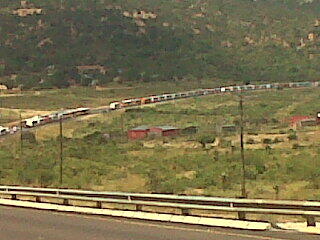
THE fabled road to Moria, on any given Good Friday, is not to be trifled with. Off the nation-long N1 at Polokwane and up towards the mountains on the R71, you are greeted with 100,000 buses in an iron-human ribbon headed stoically towards the gates of their vast Zion.

The journey is littered with those who struggle to make it. Breakdowns, crashes, toll plaza jams. But no impatience, no anger… just a vast horde of largely uniformed men and women quietly determined to be there for their Bishop at Boyne in Limpopo.

Khaki army: Inside one of the buses
On the road, they sing, dance and sell mashuda, long, noisy ribbons to supplement the dancing.
I clambered on a couple of buses while they were stopped, waiting to get past a crash not two miles from the twin gates of Moria.

The buses are largely gender specific. On the women’s charabanc, noise and children among the blue-and-white and the green-and-yellow congregants. The men sit in serried ranks, with the ubiquitous ZCC hats, khaki suits and white shoes. One long row of smiles.

Iron-human ribbon: buses on the R72 to Moria
Both are equally welcoming. Ready to talk anything from Nkosi to Amakhosi, unholy kids to holy tea. Eager to reach their destination but prepared to wait… and wait… while talking to the mad mlungu in a Kaizer Chiefs t-shirt some recognise from eTV Sunrise. 

At the end of their long road they are faced with a choice. The Dove or the Star. Founded in 1910 as a breakaway from the Scottish Free Church by Engenas Lekganyane, there are now two branches of the ZCC, with a combined congregation of around EIGHT million in a nation of 55 million.

First you come across the Star, led by Engenas’s grand-son Barnabas. Then, under a bigger, more elaborate gate, there’s the Dove sect, inspired by another grand-son, St Engenas. Insiders suggest the Star congregation is largely urban while the Doves are more rural, and draw many from neighbouring nations.

As an estimated three million people set up camp within the property of around 12 square kilometres; I expected chaos. I have seen Glastonbury and the Isle of Wight when huge concerts are held. It’s a matter of grabbing a site for your tent and a place to do your business. Disease and pollution are rampant, so is theft and beer.

On camera: the nerve centre at Moria
Not at Zion City, Moria, Boyne. Here, there is a natural order. People slip quietly in to position. Dozens of church workers are on hand to advise, guide, help. Across acres of barren veld, camps are formed, groups gather, locals stick together to sing and dance… and pray.

It took me, an mlungu (white) who grew up from the age of 10 protected by a ZCC vicar called the Reverend James “Smart” Sibanda, quite a while to take in the enormity of the organisation. If you learn one line, it’s “KGOTSONG A E BE LE LENA” (or the shorter “KGOTSO E BE LE LENA”) it means "peace be with you" and will earn access all areas.

We are gathered here today: the blue-and-white crowd
The colours are vital. Green and yellow is for the 'seaparo se segolo' (the majority, means the respectful uniform, adults only), blue and white for 'khwaere ya bomme' (choir of women), who take pride of place at the big ceremonies. Maroon and white belongs to those who help the church.
And everywhere, the army of men in hats and khaki, keeping the peace, guiding the Easter campers through the food shops and latrines in a campsite five kilometres long, speckled by loudspeakers and huge video screens.

At the gate, given my pale visage, I become a focal point. Video cameras follow my every move. Photographers save my image. I’m taken in to a plush gate house, my picture is taken for the umpteenth time and I give me name, address and religion (Methodist) before a vicar sprinkles me with holy water before I take a nervous sip.

By Easter Sunday, when Saint Engenas emerged in a Rolls Royce Phantom with eponymous number plates to give his long-awaited sermon, I had not seen a single incident of violence or theft. None of the smell of sewerage or garbage I expected. Amid the millions, peace and contentment – and plenty of dancing – reigned in the blazing African heat.

Phantastic Phnatom: St Engenas's Rolls Royce
Dancing? The spelling may not be perfect, but I’m told it’s mkhuku for men, dancing and jumping, a more demure chanting, clapping choir for women. Mphoho happens when everyone gets together to clap and get “taken by the spirit”. At midnight, every night, mphoho breaks out noisily, the camp comes alive, nirvana for three million at Zion City.

Like his father before him, St Engenas’s son drove the Roller. There is a collection of huge black limousines over the mountain at the Bishop’s home, including two Mercedes and older American Cadillacs. This is the only obvious sign of wealth on offer, though the VIP lunch lacks little.

The assembled masses go crazy. Surprisingly, the pre-sermon is given in Afrikaans by a high-pitched white man who even uses the old-fashioned term “Transvaal” for the Gauteng province. Not a murmur. Every word of every service in both Dove and Star camps is translated from the original Pedi in to English, Afrikaans, Zulu and Tsonga.

Such translations are not helpful for the flow of the message. But St Engenas has them hanging on his every word. I keep my eyes tight shut during the prayers, on advice from Twitterers concerned about my blessing levels.

In the middle of his lesson, which starts with Noah and ends with modern, troubled South Africa, a lady in blue-and-white is dragged out screaming: “taken by the spirit” the Bishop’s wife assures me.
Occasionally the frantic women in the front unleash a volley of cackling between the gentler hum of “amen”; again the spirit is to blame.

Khaki kerb stones: holding back the blue-and-white worshippers
About five metres from me, St Engenas – having ruled out talk of politics from his glass-fronted podium with Julius Malema looking on - talks of respect, crime, “looking out for our women” and “the pain of stealing”. He is no wild-eyed evangelist. No Billy Graham. Just a calm, authoritative man offering wisdom in a church where ancient African ancestors meet missionary Christianity.

During the Apartheid years, the ZCC was seen by some as counter-revolutionary but here the millions might be a quiet revolution waiting to happen. Waiting to assert their calm over a turbulent Rainbow Nation. During his speech, unexpectedly, St Engenas turns around and gives me a huge smile and thumbs up.

Deep in Moria: crowds lined the Bishop's route
Afterwards, with the crowd going utterly bonkers, he grabs my hand in his white glove. He wears an 
almost ridiculous uniform, black with lashings of gold braid, the very model of a modern major general. The family have always worn military uniform, it’s expected.

He says: “So glad to have you here, I hope you enjoy it, watch this…” and I am waved to a golf buggy with Jacques, the manager of the Magoebaskloof Hotel up the road. We are the only two white men in sight, apart from the crew who run the broadcast facility and a photographer with a fantastic Boer beard.

St Engenas takes up his mace and performs his ritual role as drum major to his ear-bashing brass band. And we surge straight in to the crowd, where a road with khaki-clad men as kerb-stones has been steam-rollered through the throng.

Drum major: the Bishop leads
Just for a second, chaos threatens. The young women in blue and white, eyes glazed, surge forward to meet their Bishop. I’ve seen crowd trouble in Umlazi and Soweto, Paris and London… but nothing like this. The road is eroded, the women reach out, inches from their prophet, their link with God.
Somehow the thin Khaki line holds. The Bishop doesn’t falter. Like the Titanic, the band plays on. Loudly. They have two marching songs, they beat still through my slumbers.

We are through the blue-and-white to the gentler green-and-gold ranks. The noise remains deafening. When Kathy Simpson won gold at the Sydney Olympics I thought my ear-drums would burst. When Jonny Wilkinson’s drop goal won the Rugby World Cup, a wall of noise assailed me. Now, I can hear nothing. For an hour afterwards my ears were ringing.

St Engenas twirls his mace with some skill. This is his time. For a good half-hour, we soldier on through the masses, past “Food Shop Number 5”, past the kiosks selling holy coffee and tea, past the endless buses, with human barriers holding back the thousands eager to see their spiritual leader. I have been on Arsenal victory parades, Olympic marches, Buckingham Palace Garden Parties. Nothing like this. Never.

Star on the hillside: Moria, Boyne, Limpopo
I look at the crowds lining the route. From tiny tots to wise old men. I catch their wild enthusiasm, high five the jumping teenagers, revel in being an obvious visitor experiencing something quite phenomenal. Unique.

And finally, unscathed, we emerge from the masses and retreat to a room upstairs in the pavilion. Outside, the crowds gather to witness one last glimpse of their bishop. Inside, St Engenas works the room, flanked by pictures of his meetings with Nelson Mandela, Thabo Mbeki and Jacob Zuma, who came last year but, perhaps significantly, wasn’t present this year.

The Bishop pumps my hand again: “Did you enjoy that? Will you come again?” He tells how he has bought “the Van Der Walt farm” over the road. How he received a prize bull as a birthday present: “And he can do the job, this bull, he has 15 cows to service!” Booming laugh. In 1996, 40 percent of black South Africans were reported to be members of the ZCC.

St Engenas moves smoothly between languages. An old white man explains how he used to serve the family at the KFC in Polokwane in the 70s, how they were always “fine people, the best”. Local politicians jostle for position. The sound and vision guy, a Greek chap who has been involved since 1998, explains how the Dove is growing.

Patrice Motsepe’s ARM directors are there, talking easily with MEPs. Of Malema, since the speech, there has been no sign. One man takes me aside. He tells me the prophecy: “One day the Dove and the Star will be reunited again. Soon. And the numbers will be incredible. We grow every year. The new farm will be for parking. We will transport the people, we get bigger every year.”

Outside, tractors pull huge green-and-yellow trailers around the site. An aerial picture on the wall shows the full extent of what we are involved in. Millions of people, thousands of buses, cars and tents, stretching for miles around.

It's late. Armoured cars filled with cash move slowly through the crowd. The financial implications of eight million-plus members doesn’t need to be spelled out. I didn’t see a single collection plate but the money offered is carefully ploughed back in to the church. It doesn’t get squandered. Corruption is a c-word here.

The Bishop is back. “Take a picture,” he beams, “You will be back. I know this. Do you need a police escort to get home? I can sort that out.”

The new garage on road to Moria: no Total Nobody's in sight
And he did. A blue and white light leads us through the throng still awaiting a final appearance. We pass the first garage beyond the gates. It’s new. It’s called “Total Nobody” in honour of a local dignitary who called himself “Nobody” to avoid an ancient curse. But here, nobody is a total nobody. All have their place in the vast ZCC scheme of things.

The drive home is terrifying. Breakdowns litter the route. The N1 tolls are heaving. Cars and buses occupy oncoming lanes. For two hours we wait, while the pilgrims, tireless, sing and dance in the buses. Home exhausted. The dominant thought: Everyone should do this, at least once.

Somewhere in the real world, Zuma is preparing to bury 13 SANDF soldiers, Arsenal won, Orlando Pirates drew, Andile Jali remains an enigma. The world goes on. Until September, when the ZCC millions gather once more.

I can’t wait. St Engenas for President anybody?